Showing posts with label Andy Foulds. Show all posts

Sunday, 16 December 2007

El Greco: a reply


Mr. Foulds, sir.

El Greco is not someone who, to date, I have spent a great deal of time trying to digest. One thing I know is he has always felt like one of those artists who does not fit historically. There is a certain crude sophisticaion, which I like.
I think the comparison between your work's intentions and El Greco's work is a pertinant one. He seems to use figural line, application and colour in order to find his own indepenndant power. The curving line, which historians seem determined to call 'mannerist', seems solid enough to justify the term sculptural.

The main thing of interst is, as you pointed out, both the application and chosen colour of his flesh tones. It is an obvious point but I don't think this can be considered on its own, its relationship to the tones of the colours around it.

He feels, to me, to do a lot of similar things to Cezanne. This is over simplisitic, but the application of colour seems to be parallel but with Cezannes being of a more retangular type. The colour range is certainly similar in what it does. Perhaps El Greco' colour range is more consistenly cool, but its function seems the same. In applying the paint in palpably present strokes and in using colours which create and capture intangible space they seem to detach the viewing space from us. Yet there seems a dichotomy, becasue it is these exact same features which seems to drag us in, eat us up. Yet we end up floating in this inbetween space, not quite capable of getting into the stage, but not also sat entirely outside of its space.

Anyway, long story short. I think this is what you are looking to do in many ways. Or at the least what 'Mary the Queen.' seems to be moving towards doing. I think linear spatial plays also have a role to play in this.
In terms of how to do this, colour wise. Fuck knows. Your use and knowledge of colour puts mine to shame. It is only recently I have made an attempt to approach colour 'scientifically'. Progress, i tihnk, is being made. Yet at the moment I very much feel I am in your shadow (shivering and feel pathetic). So, Sir, the puzzle of El Greco's colour range is something I hope you crack and I can then steal.
ps Good luck today in the game. United to steal a 2-1 victory from the jaws of defeat.

Tuesday, 11 December 2007

Sponge, swimming pools and paperwork

The source material for my painting is, thankfully, finally expanding. The process feels refreshingly natural. I have also learnt that I am sourcing things without seeing them as ever directly infilltrating into my work. The detritus of modern life, the mass of imagery we are exposed to, the frsutration with governmental systems, social/political and philosophical beliefs, my own current phycological make up and our everyday experiences are all finding there way into the fabric of my works creation.

I see this as being the final break from my idealistic belief, previously, in abstraction, autonomy and a solopsistic closed door on association. We are a product of our time and attempting to deny this is pointless.

This is not to say my work explitically deals with, describes or addresses the various speciifc sources. It is more a case that they provide a framework from which it emereges. I will give a few examples to try and illustrate my point.


1) The other day at the swimming pool I did a few lengths under water. A few always capture my attention when I do this; the sight of other shadowy figures cutting through the water, the backwards raining of bubbles as our hands slice the water, the glow of the underwater lights as we get cloers to one end. As I became consciously aware of this fascination I decided to do a few underwater tests. I dropped under water and brethed out untill I sank. The feeling of weightlessness, the moment when just enough air as left me so i float then sink, felt both relaxing and strangely moving. For that second, however pretentious, it felt like a kind of epic moment in an empty narrative.

The end of this little playful process saw me breathing out whilst on my back, untill I fel to the bottom of the pool, lying on my back. From there I watched as the bubbles from my mouth made their journey slowly to the surface. There they broke, a flurry of meaningless Icarus like forms. I raised a foot to touch the skin of the water, ripples and lines spilt across what appeared to me as a ceiling. It felt like cloud watching in some kind of other universe.

It strikes me, in hindsight, how this relates to some of my work. The direct links to upcoming floating and sinking figures is actually the link of least significance. The visual connection to my delght for bits of paint floating amoungst viscous varnished patches is also not necessarily relevant. It is some more continuous connections which fascinate me at this moment. The desire for non functional experiences and sensations over logical and reasoned thought. (yes, very Keatsian kitsh I know) The ability to find, in the most banal and unimportant of situation, a little temporary and fleeting escape from tangible reality.


2) Paperwork at college. I have already discussed this issue in some, boring, depth, in a previous post. In this instance I want to consider how it is part of my wider dislike for an over centralised government. Without Daily Mail like scare mongering I see this as a march towards a contunally more Orwellian state. Its a fucking disgrace. With power mad men at the top controlling what happens below them (well the hierachy consider it below when logic says it is beyond, its a horizontal relationship, not the vertical one New Labour has made it) They seem intent on creating limiting and restrive systemmatic blueprints. It results in a situation where you may as well have machines filling these posts. The cloining of a process results in a dumbing down of the work done, a lack of variety in approaches. in regards to lecturing and tutoring a grose irony exists. The systems are put in place to supposedly put the 'learning' (what ai disgustingly poliitcally correct term) first but actually result in them receving a narrow education. The long term prognosis is a dumbing down of the pupils as well. (and the fucking noisey moron sat opposite me does nothing to deter me from this conclusion) This is unfair to allinvovled.

This kind of connection is perhaps the most distnace from my work itself. Yet in some way, which i can't artiuclate at this moment, I see my work as emerging from such frustrations. Not as a direct commnent upon but as something which is formed from and responds too this kind of situation. A denial of this is unhelpful.

Some more to say on this but I need to get on an write my museums lecture. I have yet to decide how much to tone down its overtly anti establishment tone. Currently I am using it as the framework to comment on the ludicours beurocracy previously mentioned. The link is not as tenuous as it might sound.

Friday, 7 December 2007

Mary comments

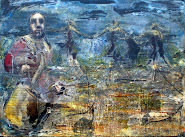
Firstly, congrats. I am so impressed how brave you have been. You have worked on this piece, I tihnk, longer than any other. Added to that you seem to believe, and I think I agree, that its your best. That dedication of time and attachment to its quality means that making any alteration takes bravery. To totally alter sections of the painting shows you are prepared to push into the unknown, to step over the edge. The success or failure of that move is actually not to important, the fact your prepared to do it is key I think.

I think you have be rewarded. I think it is a far better picture. My gut instinct says it has a colouristic clarity and weight which was lacking before. Without seeing it in the flesh that is hard to elaborate on.

The change to Mary's face is fantastic (i think). From actual specific character to a more mysterious, mask, ethereal embodiment of a wider concept. She is more challenging, more obrassive... she causes a greater interuption in the visual spectacle. The weight of focus has shifted.

The dog seems better, or am I going mad. It seems better painted and even wittier because of it. I see wit as a growing concern in my own work and soemthing you seem to be finding with great ease at the moment. Your own personal dark wit has filtered into areas of your painting. Long may it continue, as long as it remains uncontrived.

The floor is great. I love the unreality of it. It works in terms of spatial depth but then denies total entry. It seems capable of falling apart, its very construction revealed. Christ knows what I mean, its excellent though.

I am actually shattered and so therefore incoherent. I have a load of blogs to write but no time. I wanted to make sure I wrote this one tonight though, so apologies for lack of quality.

I am jealous as I think this is a really good painting.

On another point. I think I might have finished my best two paintings to date tonight. I might wake up in the morning and think they are shit.

I still need to finish drummer boy, I have a feeling he will continue to frustrate me. Particuarly as it is the closest (in style not quality) to your work, and I will feel inadequate whatever. Oh well. 'Happy days' (as my friend Tim Snaith says)

brave- impressed. willing to stand on the edge. The success or failure is actually unimportant, its that bravery that is key.

conception of the painting is the same, so I wont comment to much there

the masked face- its great. It turns her from an actual specific character to a more mysterious, ethereal emobodiment of something wider.

Monday, 8 October 2007

A new batch


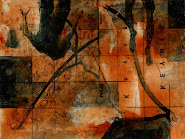
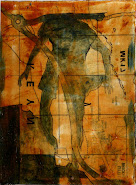
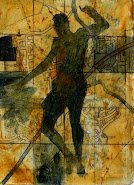
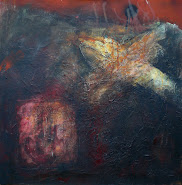
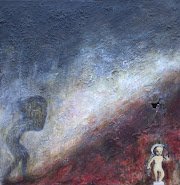
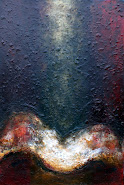
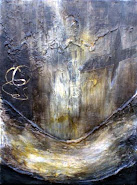
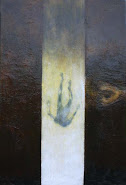
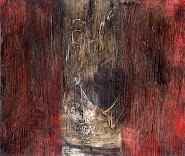
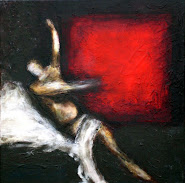
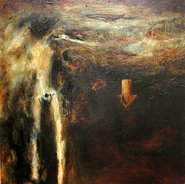
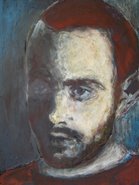
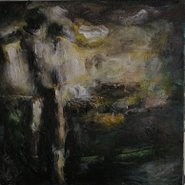
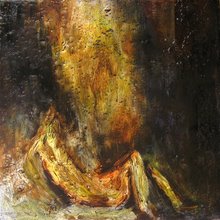
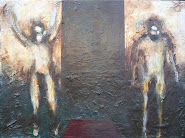
The above three pictures have all recently been completed (althyough Icarus II might need a little bit more glazing in the bottom middle section) Their completion made me realise how important working in groups has become to my work. It seems I like to have a few paintings working alongside each other, and they seem to feed each other. A lesson learnt in one place can be put into practise somewhere else.

I also noticed how in each group themes seem to exist in harmony, despite not having an predetermined desire to unite subject matter. This logic will be tested by my next three paintings as two of them push closer to abstraction and the other looks to articulate a stronger characterisation in a hunt for figuration. I am not quite sure how these new ones will work in tandem.

One of the reasons I am writting this blog is due to a technical flaw. I want to get these images up but when I uploaded onto the picture section 9to the right) the two vertical rectangular canvases have stretche dout of proportion. This is frustrating nad has happened before. I will sort it out soon with some photoshop help but thought I would add them hear in the mean time.

I am going to use the blog when I finsih every new set of works now as a quick chance to recrod my intial formal reactions. It will hopefully be a chance to not be so caught up in pretention and conception.

Lucretia: Happy with the figure in terms of drawing but not at all happy with the surface. It needs to be sexier, smoother and present the image rather than distract form it with bumps and lumps.

Endymion: The surface really works here. The glow, the breaking up of sections, the sense of light pouring from behind. I cant decide if the figures lose of solid form is a strength or a clear sign of weak underdrawing.
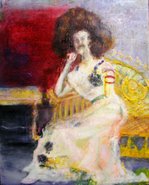

Icarus: The geometry of this work is something I am really happy about. it is more graphic than anything I have ever done before. i dont know if this is an exception or a new direction. I am also beginging to leanr how to use my colours, which is still a weakness. The greys (colbalt/burnt sienna and ultramarine/burnt umber) are started to exist in harmony. i also think that I am learning how to use the transparent yellow oxide I purchased. It gives a warm fog when laid on grey and a deep vibrant glow when brushed over a white base. It sits well in the heavy gel I have now finished, but I think it will sit better inthe thick glazing medium which is due to arrive this week.
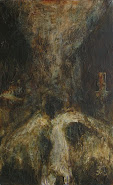
I have also purchased a transparent red oxide and a new yellow. I am going to have some fun with green for a bit. I really wanted to get Jenkins green but it was just outside my budget. Perhaps it is the arrival of autumn that has suddenly made me want to get back to green. I dont tihnk it is a colour I have ever really got to grips with. Howard Hodgkin, you basterd. :)

Right. I will be uploading the first of my recent lectures tomorrow. I need to get them online for my students and have nowehre else to put them. Hopefully they will be of some interest Andy, apologies in advance for their length. I will look into seeing if it is possible to only have a small bit on display then a link to click to get to the whole thing.

finally- on a totally seperate note. I am still in total shock regarding Englands win over Australia. One of the great great sporting shocks. Fingers crossed for Saturday.

Friday, 21 September 2007

Poem- a reply

Just an echo of a shadow...

Endymion sleeps, forever young and beautiful
Melting remote controls crawl up to the traffic lights
I suffocate you, fist down throat

The moons caresses skin with a soft and silent love call
Rainbow leaves dance there way from stage to floor
You push me away with concrete walls

Crow passes unseen to wake Endymion
A vacuous container of glossy magazines
Ended; love was not enough.

Wednesday, 29 August 2007

Titian: The Flaying of Marsyas. 1570's Tragic Drama


So much about this painting is brilliant. The theatre of its frotnality, the way marsyas is hung and presetned to us, the oppressive intensity of the shallow plane of viewing enhanced through Titian's vibrant brushwork.

The small cutsey dog, however, is perhaps the most disturbingly brilliant detail I can think of off hand in any painting I know. Its the same type of dog which sits so placidly in his earlier Venus of Urbino. Instead here is hungily laps up the pool of blood which lies below the flayed and tortured Marsyas.

Saturday, 4 August 2007

The little drummer boy.

Hey, I really liked the timbre of your last written post, I know that this blog isn't an organised writing session, more like an ideas forum, but its a pleasure to read when you write simply and honestly about concrete ideas, i think this is probably when you are at your written best. As for the little drummer, sounds interesting. I think there is something that is relevant today about the disinterested protagonist, a person who sets the rhythm from a distance, cynical, uncaring, unmoved by the events he/she has set into motion. i can't quite explain it but the character feels significant. This is why that particular character in my own work has moved from the triangular headed devil in To Want... to the central enlarged child in Mary and Ethel are Thwarted by some Disestablishmentarianism (thats the lighthouse painting) the focus has shifted the character from the periphery to the central figure. For me, i think this has become an important shift. The narrative hasn't changed as such, but the camera is in a different place, is this a little "reality tv-ish"? Even in The Dance the characterisation has become an important fator. One of the characters can see through the looking glass, out to us, the viewer. You may sense that with knowledge, this character has control, the narrator, understanding the implication of the piece and pointing the viewer towards more meaning.
I hadn't properly been able to understand this shift until reading your blog, but i believe thats it.

Friday, 3 August 2007

The Theatre of limbo

I stand before a rise and fall
All that awaits me is a plinth
On which a rotting bannana and apple sit


(apologies Andy, cluttering up the blog with crap poetry, but this is semi relevant to current paintings. Hopefully it will make sense when I post them. Although I am in danger of imploding as I get to caught up in the personal and risk being too attached for objective creation. Im only one step away from castrating myself and painting with my phallis in a pastiche of Jackson Pollock's drips.

Ritual Dance

The Crow and Bacchus fucked
Beneath the cretan crown
Ariadne's tears created a river
Bacchus' Merlot ejaculation created another.
The music began

The rivers merged and flooded
Before joining with the river lethe
Pathway to hell and drink of amnesia,
and then melting into a stream flowing with wine.
The stage was set

Four figures danced around an empty vessel
In ritual they followed the drummers beat
The pissing cupid juggled and joked
Secretely he conducted a silent tragedy.
A heavy breathe was held

The formation of a pictorial concept.

The danger of a blog site such as this is that it leads someone like myself towards pretention and self aggrandising theorising. I thought it interesting, therefore, to attempt to write something which deals with an actual process. To try and actually describe the creeative process I find myself drawn towards at this moment in time. The desire to tackle this issue arose when I was sat in slow moving traffic between Stratford and Cambridge. I suddenly became aware of my thought pattern in constructing a new painting.

For ages i have been keen to create a painting which invovles some form of ritual dance. I like the idea of paint being musical, of form having rhythm. In particualr I like the idea of forming a circle of dancers like that seen in the Bacchanal of the Andrians (Titian, part of the Camerino, c1524) A circle though which is more conscious than his, more literal if you like. I see this as being central to the composition. So this is where I start.

I like the idea of this dance having some kind of narrative context. As the source was Titians painting my mind worked towards that as a course. I thought about the River running with wine and in turn thought about the river lethe (River which runs to hell and which induces amnesia on those who drink it) So then thought that a river could somehow be invovled which is a subsiduary of those two rivers. (Not sure that is the correct geographical term, Lad?)

I also love the notion of a pissing putti in Titians painting and the outward looking putti in the works sister piece (Bacchus and Ariadne) I Want some form of figure in the piece which acts as a hiatus, which breaks the internal dynamic, which connects the painted realm to the viewers space. I also like the idea of this figure being some kind of protagonist to the events which are unfolding. The events being dance, ritualistic, mysterious. I imagine the protagonist bieng masked, maybe a juggler, maybe a clown or jester, maybe a conductor, maybe a pissing Cupid, maybe something less specific.

Suddenly sat in the car Dauiers amazing 'Saltimbanque' series came to mind (dates allude me at the moment but off the top of my head I tihnk they were between 1850 and 1860, truly amazing works and T. J. Clarks discussion of them, despite normally not being able to stand his writting, is really strong) The point is it made me think i want a drummer, or a precussionist at the edge of the painting. Like a wall which keeps our eyes in the centre and which maintains the visual rhythm of what goes on. A kind of disintrested pace setter. This also made me think of the idea of music in a visual in general, back to Keats' Ode to a Grecian Urn. 'Heard Melodies are Sweet but those unheard are sweeter.'

I then started to think about how I would put these fragments together. It was this moment that I suddenyl realised what I was doing. Filtering through a range of connected sources, letting one lead to another in a fluid stream of consciousness. Taking little clips and exceprts from various sources and removing them from the original context to construct a new, fragmented scene. I suppose the fact i am aware I can borrow from various sources without a care would be considered very postmdoern. The free quotation, the destabalised sign. Is this not, however, merely a descednat of what every figurative painter has done? Freely looked to apst sources and lifted and borrowed untill they arrive at some kind of coherence. The only difference being we don't need or want to find such a coherent outcome.

I desperately hope this explanation does not sound pretentious. All i am trying to do is account how my mind went through a few dieas. I am not pretending the ideas are any good or that the outcome will be any good at all. All I am trying to do is honestly document my mental processing and construction of a subject at this particular moment in time. By doing this I hope it will help me to realise what it is I am trying to do, where I am going wrong and where I am going right.

Wednesday, 1 August 2007

The use of drips in contemporary figurative painting

The use of the drip is a device which has art historical implications that are just as significant as painting a figure in a particular style or using a particular symbolic reference.

It may often be presumed as not having a relevance equivalent to other, more historically prescient interventions, however, as painters it is important that we understand where the choices we make have come from in context to this grand historical pursuit we have chosen to follow. It is important that we know the choices previous artists have made and why, thus, through this knowledge we avoid the danger of becoming merely painters of effects, we in turn become a relevant thread in the vast tapestry of this archaic practice.

So to the drip, which I understand made its first significant contribution during the reign of the abstract expressionists in the work of amongst others, Mark Rothko. To this artist, it appears that the drip came to signify the nature of the painting as object. there's an essay by jeffrey weiss titled Dis-Orientation which sets out to proving this hypothesis, i am not personally interested in proving whether it is right of wrong, but am instead interested in why and what effect this has had on artists today. The painting as object argument is important because it signified the artist moving more deliberately than before, away from using the canvas as the foundation for illusions of space. Manet is perhaps significant in this respect because when we look at his figures they are filled with an absence that was unseen before, which in turn I believe (but without any reading to back my theory up) was inspired by the invention of photography. We can see a subtle shift in Manets work that is corrupting the reflexive light of traditional portraiture moving it towards the surface (reflective) light of photography. The drip is a progression of this movement, it acknowledges that it is acting on a surface by moving across it without the hand of the artist to influence it. It does not ascribe to the conventions of tonality, that suggest shape and 3-dimensionality.

For painters working in the figurative realm today, their intention has been to unify the traditional skills of line and trompe l'oueil alongside the leaps in perception that were made during that extraordinary period of fervant creativity between 1850 and 1970. So with the works of Peter Doig, Matthias Weischer, Daniel Richter and others they have taken the drip and exploited its conventions moving it back towards figuration and illusion, in turns complicating and adhering to the preconceptions of the drip as belonging to the realm of the surface.